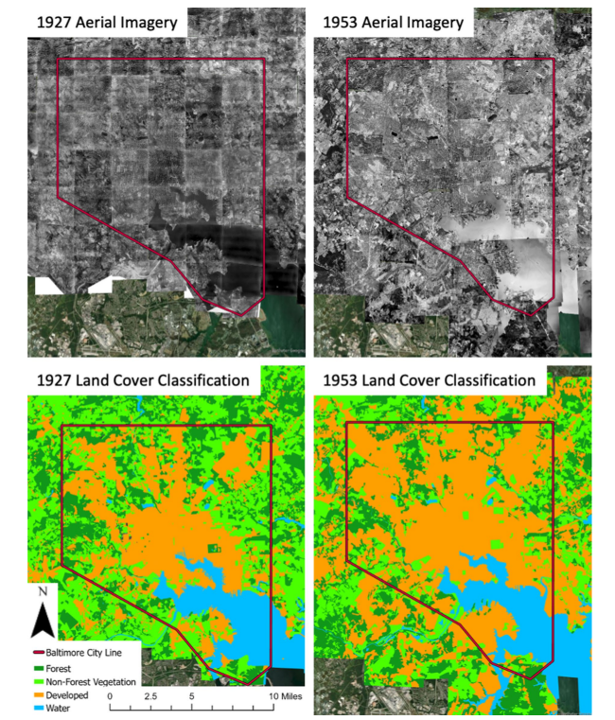
More than half of Baltimore’s current forest has been around for nearly 100 years, and almost three‑quarters has persisted since 1953. Another 30% grew in naturally over time, while about 15% formed in places that used to be developed. These patterns have important implications for present day ecology and management. Historical context is often absent from urban landscape ecology but provides information that can inform scientific inference, management approaches, and conservation priorities with limited resources for sustaining urban natural resources. Matthew Baker of UMBC will share results from systematic sampling of Baltimore’s current forest patches, along with ownership and land‑use classifications traced back to 1927 and 1953 aerial imagery, to explore how social and ecological conditions vary depending on each patch’s historical trajectory.
Matthew Baker is a Professor and Chair of the Department of Geography & Environmental Systems at UMBC. He has broad expertise in Forest, Landscape, and Aquatic Ecology, Hydrology and Geomorphology, as well as GIS and Remote Sensing. A member of the Chesapeake Bay Program’s Scientific and Technology Advisory Committee, he has provided advice and expert testimony for cities, counties, states, and federal agencies regarding the hydrologic and ecological impacts of development and subsequent attempts at restoration. For more than 15 years, he has worked with Baltimore Green Space, a nonprofit land-trust within the city, alongside scientists from the USDA Forest Service’s Baltimore Field Station to study Baltimore’s urban forests. Current research interests include studying the effects of forests and trees on urban heat, measuring the effects of urban heat on urban tree growth, understanding patterns of urban pluvial flooding, new methods for documenting the geomorphic signal of urban development, understanding patterns of stream flow permanence, improving approaches for stream assessment, and developing methods for the next generation of stream maps.
Registration
Levels:-
Donation - Suggested: $5
NHSM believes there should be no barriers to education. If you can’t pay, that’s okay. If you can pay, great. If you can pay more, please do, so this kind of education can continue. -
Education for All: $0
NHSM believes there should be no barriers to education. If you can’t pay, that’s okay. If you can pay, great. If you can pay more, please do, so this kind of education can continue.