
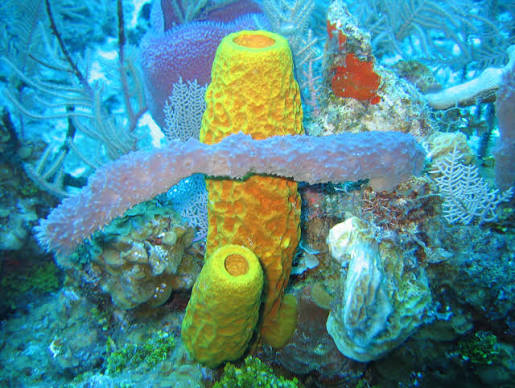
Sponges are some of the ocean’s most beautiful and underappreciated animals. They thrive in many parts of the sea, including tropical coral reefs, often called the “rainforests of the ocean.” Yet these reefs sit in surprisingly nutrient-poor waters, a bit like a bustling city in the middle of a desert. So how do they flourish?
Part of the answer lies in the microbes living inside sponges. These tiny partners help recycle essential nutrients like nitrogen and phosphorus. Among them are cyanobacteria, microbes that capture sunlight like plants do. They convert nitrogen from the water into a form other life can use, and they store phosphorus in tiny packets called polyphosphate, which act like both a battery and a pantry. Scientists think these stockpiles inside sponges may help feed neighboring reef organisms, making sponges important suppliers of a nutrient that is scarce on the reef.
Sponges and their microbial partners are also a treasure chest for medicine. They produce compounds that are a rich source of new drug candidates, offering hope for future treatments.
Join us to discover how these simple-looking animals help sustain the reef, and why protecting them matters for both the ocean and human health.
Our leader is Russell Hill, Ph.D., professor at the Institute of Marine and Environmental Technology at the University of Maryland Center for Environmental Science. Hill completed his Ph.D. at the University of Cape Town in 1988 and conducted postdoctoral studies at the University of Maryland Biotechnology Institute. He held a faculty position at IMET’s predecessor, the Center of Marine Biotechnology (COMB), worked for several years at the Australian Institute of Marine Science, and returned to COMB, where he served as professor and director from 2011 to 2025. He is a Fellow of the American Academy of Microbiology and of the Society for Industrial Microbiology and Biotechnology. He served aspresident of the Maryland Branch of the American Society for Microbiology and the International Marine BiotechnologyAssociation. Research interests include the biodiversity and functions of marine symbiotic microbes associated with marine invertebrates, particularly sponges. He studies the potential of marine microbes as sources of new drugs. He is interested in marine microalgae and associated bacteria as sources of biofuel and other products.
Registration
Levels:-
Donation - Suggested: $5
MMNS believes there should be no barriers to education. If you can’t pay, that’s okay. If you can pay, great. If you can pay more, please do, so this kind of education can continue. -
Education for All : $0
MMNS believes there should be no barriers to education. If you can’t pay, that’s okay. If you can pay, great. If you can pay more, please do, so this kind of education can continue.