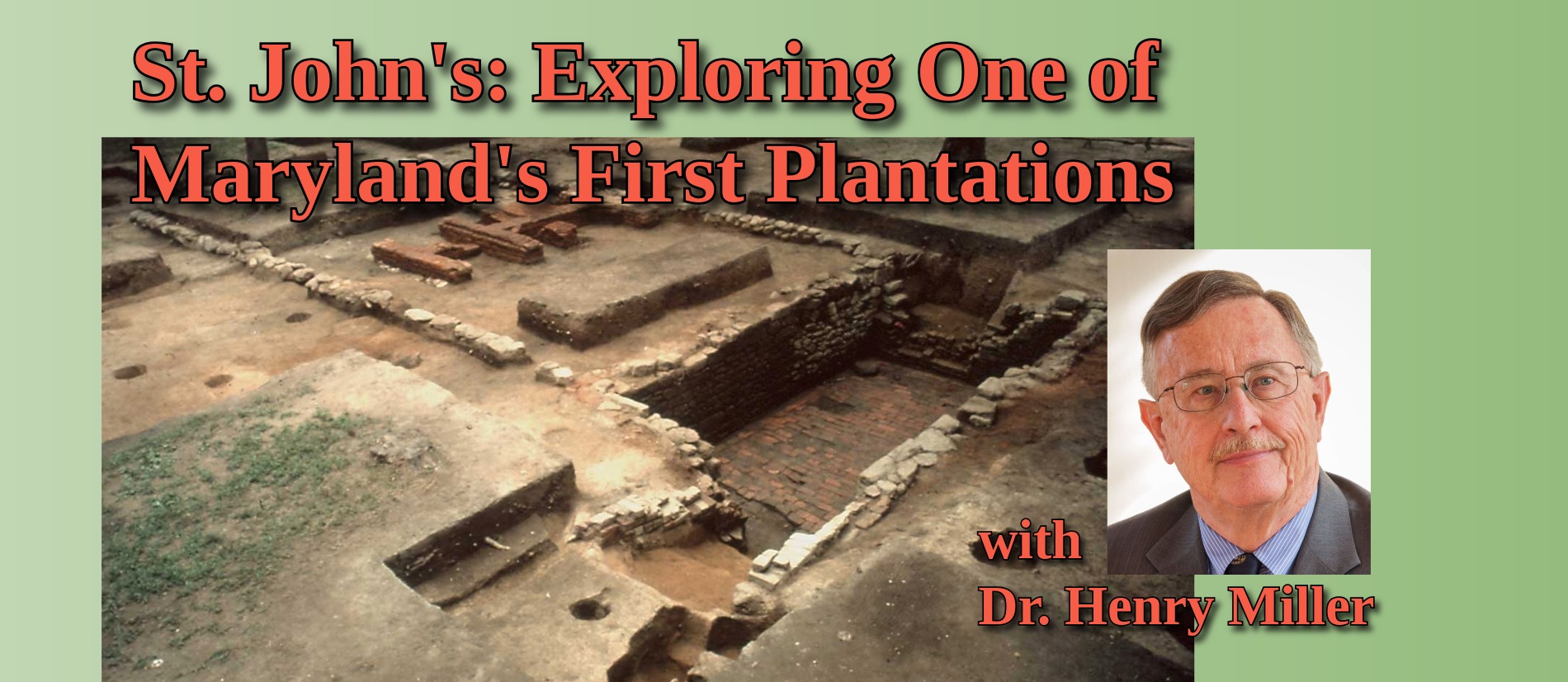
In 1638, Maryland’s first Secretary of State built a plantation he named St. John’s. It was the scene of major events in early American history, later the home of Governor Charles Calvert, then a major public inn. Occupation ended c. 1720 and it was farmed for the next 200 years. Archaeology on the site began in 1972 and it became the place where the nature of 17th-century life in early Maryland was revealed for the first time. It was also where archaeologists learned how to decipher a 17th-century site in the state. This talk summarizes the project and presents a few of the major findings from this major archaeological site ranging from architecture and yardscapes to the foods they ate.
Henry M. Miller is a historical archaeologist with a B.A. from the University of Arkansas in 1972 and a doctorate from Michigan State University in Anthropology (1984). He has worked in the Chesapeake region for over 50 years. At St. Mary’s City, he began as a digger in 1972, served as Archaeological Curator (1974, 1977-1987), Director of Research (1987-2018), and Maryland Heritage Scholar (2018-2025) for the state museum. Miller is adjunct Professor of Anthropology at St. Mary’s College where he has taught archaeology for four decades. He has led dozens of archaeological projects including surveys and full scale excavations to rediscover Maryland’s first city. These include 10 reconstructions and multiple exhibits including the 1638 St. John’s site, the 1660s Chapel and the “Quest for Freedom” exhibit about slavery at St. Mary’s City in an original 1840s slave quarter. In 2020, he received the highly prestigious J. C. Harrington Award from the Society for Historical Archaeology, the equivalent of the Nobel Prize for this field. His most recent book is Unearthing St. Mary’s City: Fifty Years of Archaeology at Maryland’s First Capital (2021). He is currently completing the reconstruction of the 1660s Brick Chapel, writing a book on this 37 year long project, advising on the exploration of the 1634 Fort where Maryland began, and assisting with development of exhibits for the new museum visitor center.
This meeting of the NHSM Archaeology Club will take place on Zoom. It is free and open to the public, although non-members are asked to please donate $5 to support the club.
When you register for the program, you’ll receive the Zoom link and passcode via email with your registration confirmation. Please contact the community coordinator (rbaldwin@marylandnature.org) with any questions.