
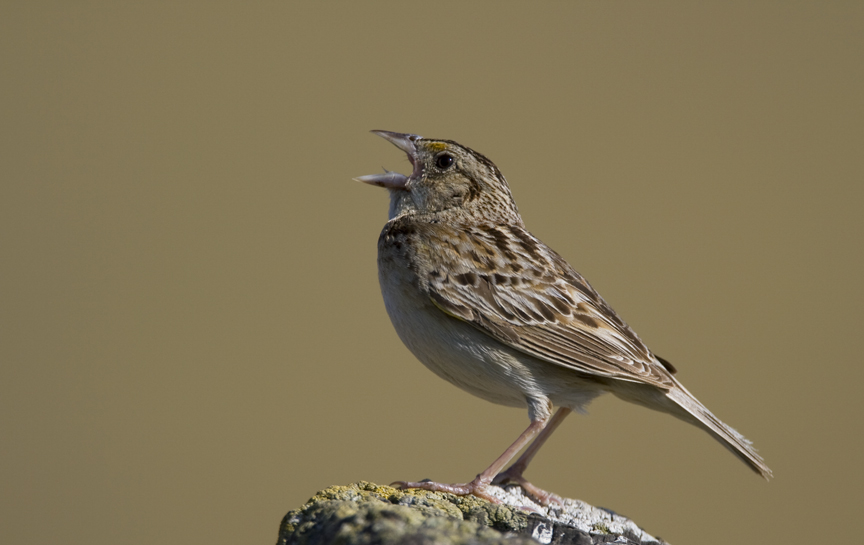
Grasshopper sparrows (Ammodramus savannarum) are small, ground‑dwelling songbirds with an insect‑like buzz that breed in Maryland. As a species of conservation concern, their breeding success is tightly linked to vegetation structure, disturbance regimes, and the acoustic challenges of low, grassy habitats.
In this talk, Dr. Bernie Lohr, a bioacoustics and auditory sensory ecology researcher at UMBC, will share new findings from his lab’s work on grasshopper sparrow vocal behavior. Focusing on how these migratory songbirds produce and perceive sound, Dr. Lohr will explore the relationship between song structure, breeding biology, and the ecological pressures shaping communication in noisy natural environments. Because grasshopper sparrows indicate grassland health, this research offers valuable insight for conservation and recovery efforts across Maryland and beyond.
Dr. Lohr is an associate professor of biological sciences at UMBC, where his lab investigates how animals encode and extract information from acoustic signals and how these processes evolve across species. His integrative research spans owls, woodpeckers, geckos, and other taxa, but songbirds remain a central model for understanding the interplay between signal production, signal perception, and the acoustic environments in which communication occurs. His work combines behavioral ecology, sensory biology, and conservation‑focused research to illuminate how animals navigate the challenges of communication in the natural world.
Registration
Levels:-
Donation - Suggested: $5
NHSM believes there should be no barriers to education. If you can’t pay, that’s okay. If you can pay, great. If you can pay more, please do, so this kind of education can continue. -
Education for All : $0
NHSM believes there should be no barriers to education. If you can’t pay, that’s okay. If you can pay, great. If you can pay more, please do, so this kind of education can continue.