The Chesapeake Bay Impact and Other Tales from my Life as a Paleontologist
Thu, April 9, 7pm - 8pm
This event has passed.
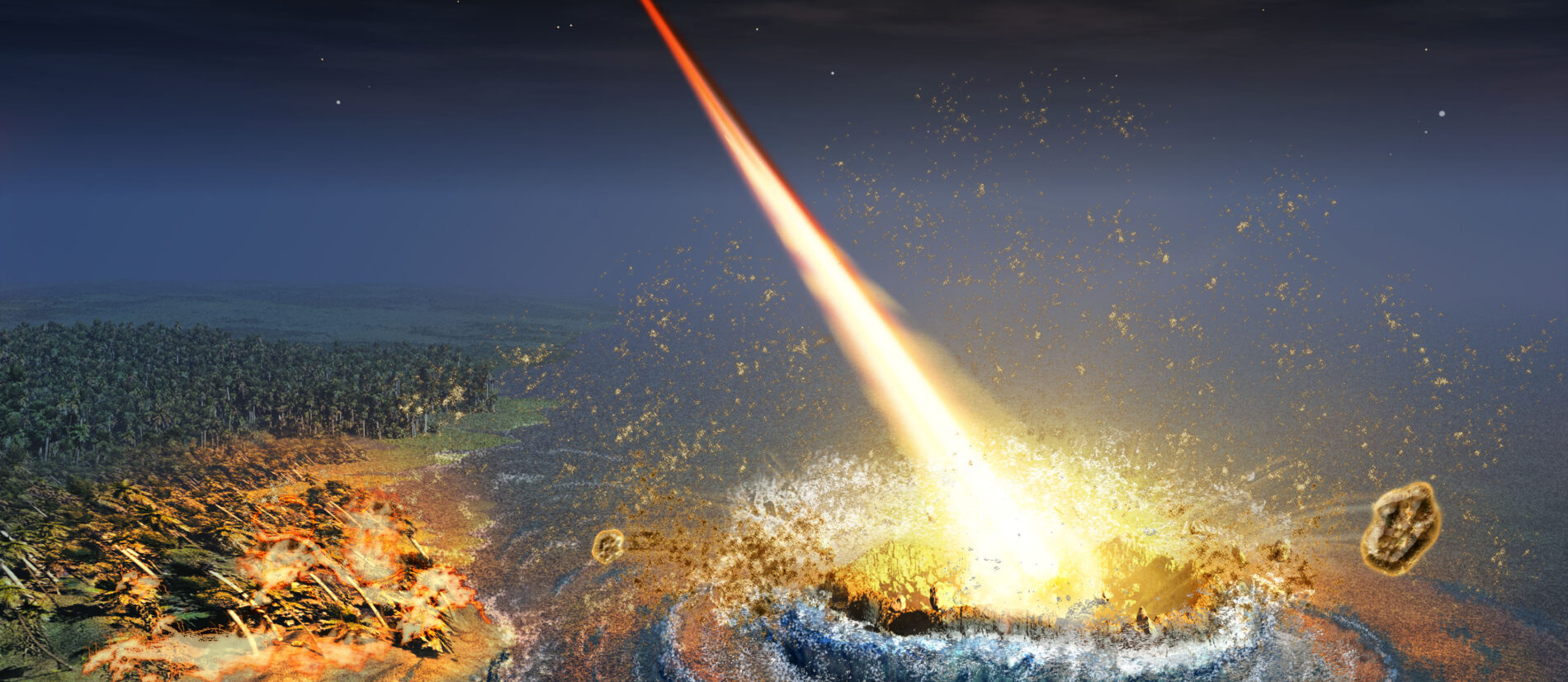
Nearly 35 million years ago a meteor or asteroid crashed into the Chesapeake Bay on the east coast of the United States creating a 12 mile wide crater. The last stage of the eocene, early mammals roamed the Earth when the mid-Atlantic coast had a tropical climate and vegetation.
science, art, illustration, technical, landscape, ecology, nature, processes, earth, history, archeology, geology, meteor, asteroid, extinction
After 40 years as a paleontologist, Dr. Lucy E. Edwards retired from the U.S.Geological Survey. Lucy attributes her success to a combination of being in the right place at the right time, a lot of hard work, and a brain that just happened to be wired to think like a paleontologist.
The fossils she studies are the cysts of dinoflagellates – a type of algae, small, wax-like hydrocarbon structures that are neither plant nor animal – which are most often found in nearshore muddy deposits. They help determine the age and environment of ancient deposits, often as part of groundwater studies.
The work involved a fair amount of time “sitting on a drill rig,” and much more time looking at the dinoflagellate cysts brought up in the sediments. In all that looking, Lucy has named several new species and one new genus; and has had several species and one genus named after her.
The highlight of Dr. Edward’s career was her involvement in the discovery and decades-long study of the Chesapeake Bay impact structure, which was formed 35.5 million years ago in what was then a shallow part of the Atlantic Ocean. The fossils in and around the now-buried crater were first a mystery to her and then a series of logical consequences of the massive impact.
In this presentation, Lucy will share additional vignettes on how to interest others in science, other impact areas and craters, and what else dinocysts can tell us.
Lucy E. Edwards focuses her research on the stratigraphy of the Atlantic and Gulf Coastal Plains. Her specialty is dinoflagellates, and she studies their fossil cysts to reveal the time and environment of deposition and how they came to be preserved in the fossil record. She also specializes in stratigraphic nomenclature and methods of stratigraphic correlation. She received her BA (Honors College) in Geology from the University of Oregon in 1972 and her PhD in Geological Sciences from the University of California, Riverside, in 1977. She has taught courses at George Washington University, Indiana University, University of Kansas, University of Oslo, George Mason University, and Türkiye Petrolleri AO. She is a fellow of the American Association for the Advancement of Science, the Geological Society of America, and the Paleontological Society. As a graduate student, she worked two summers for Exxon Production Research Co. in Houston.